The London Coffee House: A Social Institution
by Deborah Hale
April 2003
"Remember, John,
If any ask, to th' Coffee House I'm gone.
Then at Lloyd's Coffee House he never fails
To read the letters and attend the sales."
If any ask, to th' Coffee House I'm gone.
Then at Lloyd's Coffee House he never fails
To read the letters and attend the sales."
 So went popular doggerel, during the two centuries (1650-1850) when the coffeehouse served Englishmen as a composite office, club and post box. As a social institution of the 18th century, the coffeehouse cannot be overestimated.
The hot stimulating beverage, which provided this focus for sober socialization, originated in the Near East. Spreading rapidly through the Moslem world, it was gradually introduced into Europe during the sixteenth century. By 1637, the diarist John Evelyn knew a Greek scholar at Balliol who brewed his own coffee. In that cosmopolitan university town of Oxford, the first English coffeehouse opened its doors in 1650.
Two years later, a Greek proprietor established the first London coffeehouse, in St. Michael's Alley, Cornhill. Immediately and time-wastingly popular, by 1675 when Charles II closed all the coffeehouses in his realm, calling them "seminaries of sedition", their number totaled three thousand! So overwhelming was public pressure that the king rescinded his order in a matter of days. During Queen Anne's reign, London alone boasted nearly five hundred coffeehouses, each with its unique character and clientele. An amusing sketch in the Spectator records the different reactions to news of the death of King Louis XIV, at eight coffeehouses between St. James and Garraways.
Unlike the café‚ of Continental Europe, the English coffeehouse served business as well as social purposes. In Ned Ward's Wealthy Shopkeeper, 1706, his daily routine went as follows: "Rise at 5; counting house till 8; then breakfast on toast and Cheshire cheese; in his shop for 2 hours; then a neighbouring coffeehouse for news; shop again till dinner…1 o'clock on change; 3 Lloyd's Coffeehouse for business; shop again for an hour; then another coffeehouse (not Lloyd's) for recreation." Businessmen often kept regular hours at a particular house, where clients would know to find them.
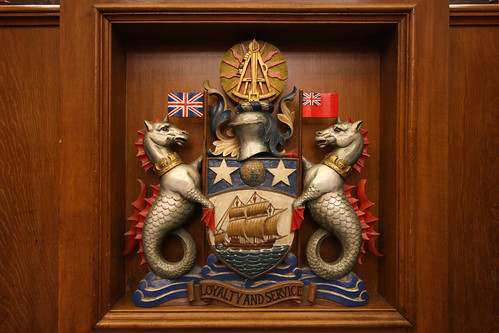
Gradually, certain establishments began to attract men with specific common business interests. The Jamaican Coffeehouse drew West Indian traders, while India and China merchants frequented Jerusalem and exchange brokers gathered at Jonathan's. Garraways, in Exchange Alley, catered to the tea trade. In 1744, London's Baltic Mercantile and Shipping Exchange had its beginnings in the Virginia and Baltic Coffeehouse, an outgrowth of the Virginia and Maryland. On the vast marble floor of the exchange, shippers and agents matched vessels and cargoes in secretive deals called "fixtures".