________
The Taliban Does It Again!
By James Corbett | November 16, 2025
The United Nations Office on Drugs and Crime (UNODC) just came out with their latest survey of opium poppy cultivation in Afghanistan, and you'll never guess what it says. . . .
. . . Oh wait, you totally will. It turns out the Taliban's ban on poppy cultivation has been remarkably successful!
Specifically, the UNODC is estimating the total area in Afghanistan under opium poppy cultivation to be 10,200 hectares, down 20% from last year's total of 12,800 hectares. While the new total may still sound like a lot, it's a mere fraction of the 232,000 hectares that were estimated to be cultivated in the year before the US military's spectacular pullout from the country in 2021.
In other words, the Taliban have somehow or other succeeded in doing what NATO was unable to do in two decades of de facto occupation: decimate Afghanistan's share of the global heroin trade. [Editor's note: See the latest from NATO.]
So, what's happening here? What does this tell us about the true nature of the global drug trade? And what does all this have to do with the United States' coming (real) war on Venezuela's (fake) fentanyl trade? Let's find out.
TALIBAN 2 NATO 0
In 1999, for example, they warned that Afghanistan's raw opium production had risen to the unprecedented level of 4,600 metric tons.
Their 2001 survey, however, showed that that number had plummeted to a mere 185 metric tons—a whopping 96% drop.
It isn't hard to identify the plummet in the graph of opium poppy cultivation in Afghanistan. Here, let me show you:
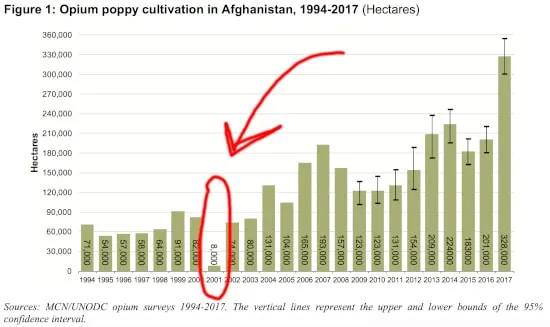
And what happened after 2001, where the chart shows a steady increase in opium poppy cultivation in Afghanistan? The US-led NATO invasion happened, that's what!
As we all know, that invasion was a travesty based on a secret lie. One of the fully intended effects of the NATO invasion was the revivification of Afghanistan's heroin trade, a tale told, as I said, in the annals of the UNODC.
By 2007 the once-nearly-eradicated Afghan opium poppy was back in full bloom. That year, the UNODC documented a record 8,200 tons of opium production.
That record was surpassed in 2013, when the UNODC showed a fresh record high of opium cultivation.
The 2013 record was surpassed yet again. In 2017, the UNODC survey recorded 9,000 tons of opium production in the country.
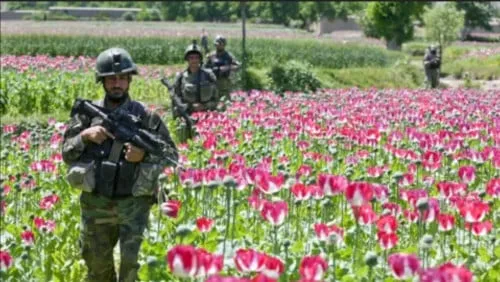
Along the way, this wild ride of opium-producing and heroin-running—all taking place under the supervision of US/NATO forces—saw some eye-opening reports, like when Geraldo Rivera interviewed USMC Lt. Col. Brian Christmas, who was forced to admit that the troops were there in Afghanistan not to destroy the poppy crop or to stop the heroin trade, but to guard the poppy fields.
Please go to substack to learn more.
________
From the AD archives:
Supply chain shifts from opium and heroin to fentanyl
Britain controls triangular trade: drugs; sex trafficking; guns
Dope Inc.: Britain's Opium War Against the U.S.
Parasites inside our military brain - opium production: breathtaking - kew gardens to the fields of afghanistan - helicopter gunship tour of Dope Inc.
$600 billion per annum and growing - a brief history of opium - guilty farmers - c.3400 B.C. to May 2010
worked during vietnam why not in afghanistan? - transporting heroin on the cheap - we need another investigation - blown cover-for-cover

No comments:
Post a Comment
Note: Only a member of this blog may post a comment.