________
Florida residents opposed a $7B electric rate hike. Regulators OK'd it anyway
November 21, 2025 | By Keaton Peters
Twelve million Floridians will see higher electric bills in the coming years after state regulators approved a $7 billion rate hike. Following months of legal maneuvering, the Florida Public Service Commission gave the green light on Thursday for Florida Power & Light (FPL) to increase the rates of 6 million customers through 2029.
Florida residents opposed a $7B electric rate hike. Regulators OK'd it anyway
November 21, 2025 | By Keaton Peters
Twelve million Floridians will see higher electric bills in the coming years after state regulators approved a $7 billion rate hike. Following months of legal maneuvering, the Florida Public Service Commission gave the green light on Thursday for Florida Power & Light (FPL) to increase the rates of 6 million customers through 2029.
The five-member utility regulatory board appointed by Gov. Ron DeSantis, R, voted for the settlement reached after FPL initially proposed a $10 billion rate hike in February. In 2029, a typical household consuming 1,000 monthly kilowatt-hours will pay $148 per month. That's about $7 more for customers in northwest Florida and a $14 increase for the rest of FPL's territory, which includes all of South Florida and the state's East Coast.
The settlement did not have the support of the Florida Office of Public Counsel, which represents utility customers. FPL's initial proposal also faced backlash from the AARP and various environmental and consumer advocacy groups.
In a press release, FPL said the new rates will ensure the grid remains reliable and allows the state to continue on a growth trajectory — a sentiment echoed by many public service commissioners when voting in the settlement's favor.
Florida is not alone in raising electricity rates. Across the country, utility companies are asking regulators to approve rate hikes, and high electric bills have already sparked strong political backlash. The approved settlement also includes measures to manage the influx of data centers that the tech industry is intent on building to power artificial intelligence tools. The approval of FPL's rate hike has raised concerns that Big Tech may be getting a better deal than the average Floridian.
Why is Florida's electricity rate hike controversial?
Shelby Green, research and communications manager at the nonprofit watchdog group Energy and Policy Institute, said "this decision just kicks the can further down the road for affordability in Florida."
Many residents already struggle to pay their monthly bills. In 2024, nearly 1.3 million FPL customer accounts, which translates to about 3 million people, had their power disconnected over nonpayment, according to legal filings. Florida is also one of only six states that do not prevent utilities from shutting off customer's power during extremely hot or cold weather.
Green told Straight Arrow News that the disconnection data demonstrates that many Floridians are at their financial brink. The average FPL customer will pay close to $600 more per year for electricity in 2029 than in 2021, Green said.
The guaranteed profit margin FPL makes on infrastructure investments — known as a return on equity or ROE — is also set to increase to 10.9%, which opponents argue is too high.
Please go to SAN to continue reading.
________
There are over 11,000 data centres worldwide; where are they and why do they want them?
By Rhoda Wilson | November 19, 2025 | 13 Comments
Visual Capitalist has mapped where in the world the approximately 11,000 to 12,000+ operational data centres are located. What do they need all these data centres for?
"Data centres are the backbone of the digital economy, storing, managing and processing the world's data. In this graphic, we visualise the countries with the most data centres as of November 2025, revealing where the world's digital infrastructure is concentrated," Visual Capitalist said and produced the image below.
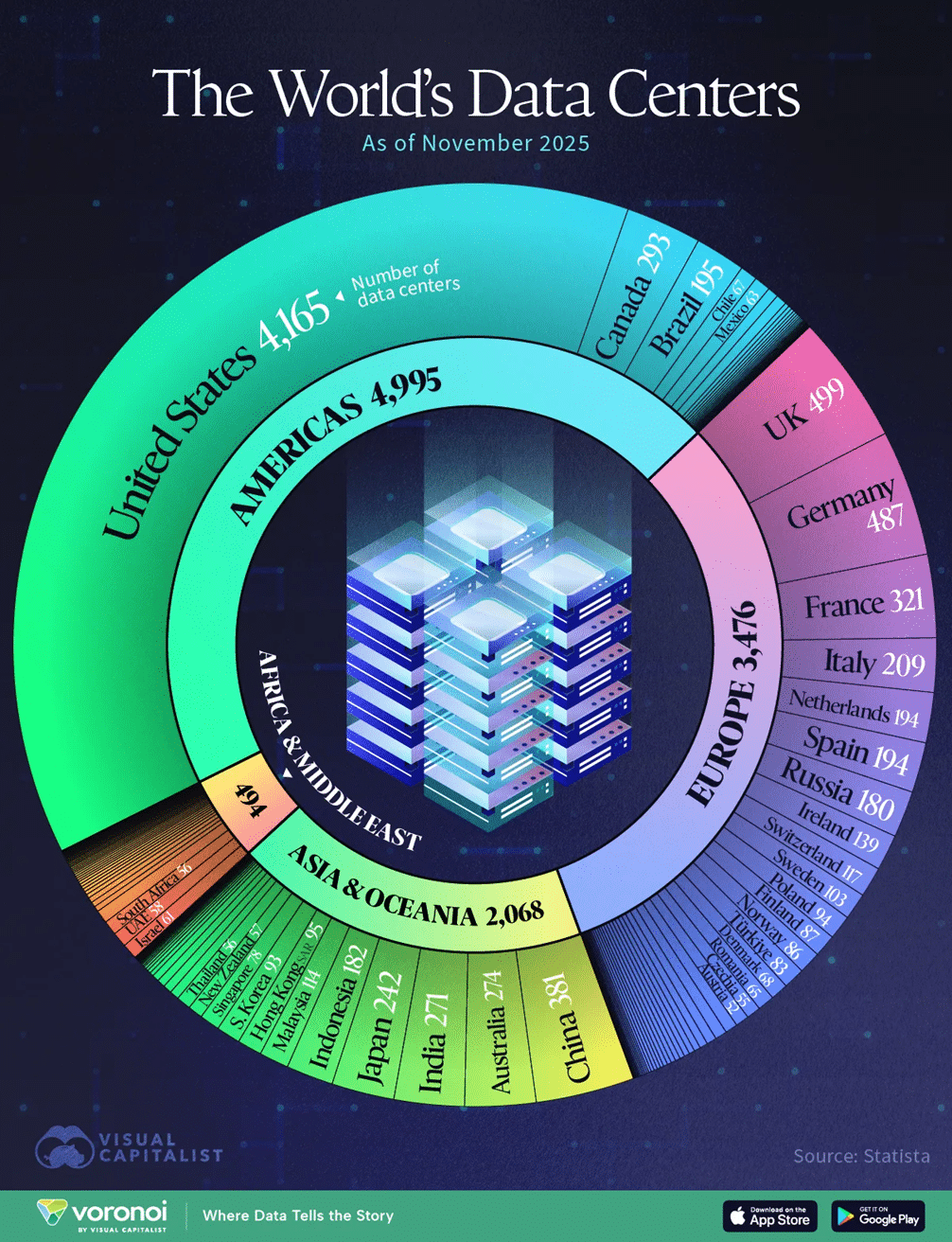
What do they plan to use all these data centres for? The following recently published articles give us some idea. To read the full article, follow the hyperlink in the subtitle.
We're Making Utter Fools Of Ourselves While Claiming To Have Reached The Apex Of Wisdom
Society seems to be rushing headlong toward replacing God and humans with "giant statistical prediction machines" in a trend that seems as inevitable as it is concerning. Last week, an Axios report heralded the rise of "chatbot Jesus" and AI pastors. The day following that report, a video advertising a service to turn deceased loved ones into eternal virtual companions went viral.
These ominous news bits come on the heels of Sam Altman's announcement that ChatGPT would now offer erotica to its adult customers (and Elon Musk's xAI already offered similar degenerate features). But as much as society is bent on its rushing, there's an age-old warning that should cause humanity to pause: We become like what we worship. [Editor's note: Sam Altman is an intelligence agency cutout and fraud pulled out of Stanford.]
Paul McCartney to Release Silent AI Protest Song After UK Relaxes Copyright Protections for Tech Firms Legendary Beatles singer Paul McCartney will be releasing a silent music track next month in protest of the United Kingdom relaxing copyright protections for tech firms to push generative AI.
Artists have alleged that a recent change in copyright law “would make it easier to train AI models on copyrighted work without a license."
"Under the heavily criticised proposals, UK copyright law would be upended to benefit global tech giants. AI companies would be free to use an artist's work to train their AI models without permission or remuneration," the artists said, adding that changes “would require artists to proactively 'opt-out' from the theft of their work – reversing the very principle of copyright law."
There are over 11,000 data centres worldwide; where are they and why do they want them?
By Rhoda Wilson | November 19, 2025 | 13 Comments
Visual Capitalist has mapped where in the world the approximately 11,000 to 12,000+ operational data centres are located. What do they need all these data centres for?
"Data centres are the backbone of the digital economy, storing, managing and processing the world's data. In this graphic, we visualise the countries with the most data centres as of November 2025, revealing where the world's digital infrastructure is concentrated," Visual Capitalist said and produced the image below.
Visualising All of the Worlds Data Centres in 2025 Visual Capitalist 19 November 2025
What do they plan to use all these data centres for? The following recently published articles give us some idea. To read the full article, follow the hyperlink in the subtitle.
We're Making Utter Fools Of Ourselves While Claiming To Have Reached The Apex Of Wisdom
Society seems to be rushing headlong toward replacing God and humans with "giant statistical prediction machines" in a trend that seems as inevitable as it is concerning. Last week, an Axios report heralded the rise of "chatbot Jesus" and AI pastors. The day following that report, a video advertising a service to turn deceased loved ones into eternal virtual companions went viral.
These ominous news bits come on the heels of Sam Altman's announcement that ChatGPT would now offer erotica to its adult customers (and Elon Musk's xAI already offered similar degenerate features). But as much as society is bent on its rushing, there's an age-old warning that should cause humanity to pause: We become like what we worship. [Editor's note: Sam Altman is an intelligence agency cutout and fraud pulled out of Stanford.]
Paul McCartney to Release Silent AI Protest Song After UK Relaxes Copyright Protections for Tech Firms Legendary Beatles singer Paul McCartney will be releasing a silent music track next month in protest of the United Kingdom relaxing copyright protections for tech firms to push generative AI.
Artists have alleged that a recent change in copyright law “would make it easier to train AI models on copyrighted work without a license."
"Under the heavily criticised proposals, UK copyright law would be upended to benefit global tech giants. AI companies would be free to use an artist's work to train their AI models without permission or remuneration," the artists said, adding that changes “would require artists to proactively 'opt-out' from the theft of their work – reversing the very principle of copyright law."
Please go to The Expose to continue reading.
________
This is so fucked up where does one even begin trying to make sense of it? All these data centers to run AI (despite the AI bubble bursting) will be used to make life decisions for those stupid enough to allow AI intruding on their lives? And the thing is in Florida even if you don't use the technology related to any of these data centers you will be required to pay for it anyway because you can't opt out. If you refuse to pay there are no laws in Florida to prevent the electrical utility from shutting your power off. How's that for democracy?
More People Using AI For Key Life Decisions: Are We Giving Up Control?
Slouching Toward Technocracy: Is The World Giving In?
Slouching Toward Technocracy: Is The World Giving In?
This is why these people do not want states interfering in AI infrastructure:
Trump, Republicans try again to stop states from regulating AI
Trump, Republicans try again to stop states from regulating AI

No comments:
Post a Comment
Note: Only a member of this blog may post a comment.